Psoralea corylifolia is also known as Babchi, Vakuch, Lata Kasturi, Bavachi, Bawachi, Karpo-karishi Kani Bogi and Kushtanashini (leprosy destroyer). It is one of the main plant used in treatment of leucoderma, psoriasis, Leprosy, intestinal worms and skin complaints.
It is used in homeopathy and other traditional medicines such as Ayurveda and Siddha. Psoralea corylifolia is reported to be grown in Rajasthan and eastern district of Punjab adjoining Uttar Pradesh for its seeds. The seeds are used in indigenous medicines. The seeds have been reported to have antiseptic properties as well. Babchi seeds contain an essential oils (0.05%), a non-volatile trepenoid oil, a dark brown resin (8.6%), a pigment (hydroxyflavone), a monotrepnoid phenol(bakuchiol), a brown fixed oil (10%), raffinose, coumarin compounds, albumin, sugar, ash 7.5 % and a trace of manganese. Psoralen and isopsoralen are therapeutically active constituents.
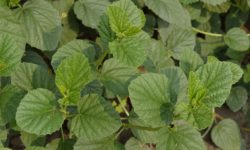
Biswarup Ganguly [GFDL (http://www.gnu.org/copyleft/fdl.html), CC BY 3.0 (http://creativecommons.org/licenses/by/3.0), GFDL (http://www.gnu.org/copyleft/fdl.html) or CC BY 3.0 (http://creativecommons.org/licenses/by/3.0)], via Wikimedia Commons
According to the Chinese Pharmacopeia, it has been used as a medicinal herb for warming kidney and activating yang, promoting inspiration and checking diarrhea. The seeds of Psoralea corylifolia are known as “Buguzhi” in traditional Chinese medicine and used therapeuticaaly for various kinds of disorders such asthma, cough, nephritis, vitiligo and cavities.
It is very important remedy for leukoderma. It has a powerful action against the skin streptococci. Locally it is very beneficial in the treatment of leukoderma. It dilates the arterioles of body. It use directly act on melanin (pigment in skin) leading to pigment formation which diffuses into the decolorized leucodermic patches.
Psoralea Corylifolia Names, Plant Description and Taxonomy
Psoralea corylifolia is naturally an endangered plant and found in tropical and subtropical region of the world. Its medicinal usage is reported in Indian pharmaceutical codex.
Psoralea corylifolia belongs to Fabaceae family. It is and erect annual, 30-180 cm high, could almost throughout India. It is reported to be grown on some extent in Rajasthan and the eastern districts of Punjab, adjoining Uttar Pradesh for its seeds. The fruits of P. corylifolia consist fo a sticky oily pericarp, a hard seed coat and kernel. The seeds possess anthelmintic activity against earth worms, psoralen being the active principle. Its root is useful in the caries of teeth.
Seeds are brownish black in colour, oblong, and flattened. These are kidney shaped, 2-4 mm long, 203 mm broad, and 1-1.5 mm thick, hard, smooth, with an agreeable aromatic odour and pungent-bitter taste. Leaves are simple, broadly elliptic, rounded, and have white hairs on both surfaces, covered with numerous black dots. Flowering time is from August to December. Fruit is small, slightly compressed, pitted black, beaked without hairs.
Distribution-The plant grows in tropical and subtropical regions of the world including Southern Africa, China, and India. It is also found throughout India in Himalayas, Dehradun, Oudh, Bundelkhand, Bengal, Mumbai, Bihar, Deccan and Karnataka.
Cultivation– The plant thrives well in areas with low to medium rainfall during the summer months and on a variety of soils ranging from sandy, medium loam to black cotton in dry tropical regions of India.
Common names
- Arabic: Loelab el abid, Mahalep
- Assam: Habucha
- Bangladesh: Buckidana
- Bengali: Bavachi, Hakuch, Latakasturi, Kakuch, Barachi, Bakuchi Bomb: Bawachi, Bobawachi
- Chinese: Ku Tzu, Pu Ku Chih, Bu Ku Zhi, Cot Chu
- English: Babchi seeds, Psoralea seeds, Malay tea, Scurf-pea, Fountain bush, West Indian Satinwood
- German: Bawchan
- Gujrati: Babchi, Bavacha, Babichi, Bawchi
- Hindi: Babachi, Babchi, Bavanchiyan, Bhavaj, Bakuci, Bemchi
- Kannada: Somaraji, Bavanchigida, Karbekhiga
- Kashmiri: Babchi
- Malayalam: Karkokil, Karkokilari, Kaurkoalari
- Marathi: Babachi, Bavachya, Bavachi, Bavanchi
- Nepalese: Bakuchi
- Oriya: Bakuchi
- Persian: Waghchi, Vabkuchi, Ba bakhi
- Punjabi: Babchi
- Sanskrit: Aindavi, Avalguja, Bakuchi, Chanderlekha, Chanderprabha, Kushthahantri, Sitavari, Somaraji, Vejani, Vakuchi, Sugandha kantak, Krishnaphala, Chandraraji, Asitatvacha, Kalameshi, Somavalli, Bakuci, Sasankarekha
- Sinhalese: Bodi- ata
- Sri Lanka: Ravoli
- Tamil: Karpokarishi, Karpuva-arishi, Karpuvanshi, Kaarboka-arisi, Karpogalarisi
- Telugu: Bavanchalu, Bavanchi-vittulu, Bogi-vittulu, Karu-bogi, Kala-ginja
- Urdu: Babechi
Taxonomic classification
Kingdom: Plantae
- Division: Angiospermae
- Class: Dicotyledoneae
- Order: Rosales
- Family: Leguminosae
- Subfamily: Papilionaceae
- Genus: Psoralea
- Species: corylifolia Linn
- Natural order- Leguminoceae.
In Homeopathy, all parts of Psoralea corylifolia are used for medicinal purpose.
The various parts of plant has different use-
1. Seeds are sweet, bitter, acrid, and astringent. These are useful for improving digestive, gaining strength, and receptive power of mind. It should be kept in mind that though babchi, seeds are taken orally, can various health conditions, such as an intestinal worms, but overdose of babchi seeds could bring about some adverse side effects, such as headaches, nausea, diarrhoea and vomiting. Seeds are antipyretic which is helpful in lowering fever. It is important remedy for menstruation disorder, and uterine haemorrhage. It is useful in treatment spermatorrhoea and premature ejaculation. The seeds can heal ulcer, heart troubles, and cure blood disorders.
2. Roots– Roots re useful in treating the caries of the teeth. P. corylifolia is used to promote bone calcification, making to useful for treating osteoporosis and bone fractures.
3. Leaves are used to given relief from diarrhoea.
4. Roots– It helps to prevent vomiting, cures difficulty in urination, used in treating piles, bronchitis, and anaemia and improves complexion. The fruit of the P. corylifolia plant can be used on genital organs, as tonic. The fruits are generally used for treating fever like conditions, bed wetting, and lower backaches. It helps to restrict the growth of mycobacterium tuberculosis.
Mother Tincture PSORALEA CORYLIFOLIA MT Availability
Schwabe India PSORALEA CORYLIFOLIA MT, 1X (Q) (30ml) @ Rs. 85.00
SBL Psoralea Corylifolia 1X (Q) (30ml) @ Rs. 65.00
KYA PSORELEA CORLIFOLIA SAFED DAAG MEIN PEENE KE SATH- SATH BODY MEIN LAGANE MEIN BHI LAGA SAKTE HAIN AUR KYA ISKA LAABH MILEGA
what about vitiligo,how does it work in cases of vitiligo……..is there any mechanism by which u can make us understand the modus operandi of this drug?
read article, Author had clearly mentioned about it.